Capability-First & Outcome-Driven Enterprise Roadmaps (1/3): Why Most Enterprise Roadmaps Fail Before They Start
Part 1 of 3 — Capability-First & Outcome-Driven Enterprise Roadmaps

- Part 1: Why Most Enterprise Roadmaps Fail Before They Start (you are here)
- Part 2: The Assessment Blueprint: From Capability Gaps to Transformation Actions
- Part 3: What This Looks Like in Practice: Banking and Insurance Simulations
The Three Statements That Kill Your Roadmap
If you’ve been in enterprise technology long enough, you’ve heard these in every planning cycle:
“We need to migrate to the cloud to reduce infrastructure costs.”
“Our systems should be microservices-based for better scalability.”
“Let’s modernize our entire technology stack.”
These statements sound forward-thinking. They’re not wrong, technically. But they share a common problem: they start with technology and work backwards to find a business justification.
This is the IT-first roadmap trap, and most enterprises are stuck in it.
The roadmap becomes a technology wish list. It gets funded, executed, and delivered, and yet the business doesn’t move. Customers don’t see a difference. Revenue doesn’t grow. The CIO is left explaining “workloads migrated” to board members who don’t care about workloads.
I’ve seen this pattern across financial services, telecom, and retail. The technology team works hard, delivers on time, and still fails to move the business forward. Not because the technology was wrong, but because the starting point was wrong.
The IT-First Roadmap Trap
The fundamental issue with IT-first roadmaps is that they frame technology as the goal, not the enabler. Here’s how it plays out:
1/ IT defines priorities based on infrastructure age, technical debt, or vendor end-of-life schedules.
2/ Business teams are consulted after the roadmap is built, for “alignment.”
3/ Execution begins with technology delivery as the primary measure of success.
4/ Business outcomes are assumed to follow, but no one tracks them.
The result? Technology teams deliver projects. Business teams don’t see value. The disconnect widens every quarter.
flowchart TD
    A["IT Defines Tech Priorities"] --> B["Cloud Migration / Modernization"]
    B --> C["Invest in New Platforms & Tools"]
    C --> D["Deliver on Time & Budget"]
    D --> E["Business Expectations Not Met"]
    E --> F["Stakeholder Frustration"]
    F --> G["Low Business Impact"]
    style A fill:#7f1d1d,color:#e7e5e4
    style G fill:#7f1d1d,color:#e7e5e4
This isn’t a delivery failure. It’s a framing failure. The roadmap was never connected to what the business actually needs to achieve.
The Four Patterns That Show Up Every Time
The failure of IT-first roadmaps isn’t about poor execution. It stems from a fundamental misunderstanding of how technology should serve the business. Four patterns show up again and again.
1/ Technology-driven priorities over business outcomes
A roadmap built around technology-first initiatives starts with statements like “we need AI-driven automation” or “we must implement blockchain.” But why? What customer problem does it solve? What revenue does it unlock?
If there’s no clear business justification, improving operational efficiency, enhancing customer experience, or increasing revenue, then these projects become costly experiments. They pad resumes, not balance sheets.
2/ No measurable business impact
IT-first roadmaps define success in terms of deployment metrics. A cloud migration is “successful” if workloads move on time and within budget. But what if customer service response times remain the same? What if fraud detection accuracy doesn’t improve?
Without KPIs tied to revenue, efficiency, or customer experience, these initiatives look great on a status report and invisible on a P&L.
3/ Siloed execution, disconnected teams
When IT teams build solutions in isolation, they optimize for technical elegance, not business workflows. A microservices architecture may make infrastructure more flexible, but if business teams can’t adapt to new workflows, adoption stalls and benefits remain theoretical.
A roadmap must be an enterprise-wide initiative. If business units aren’t co-owners, they become passive recipients. Passive recipients don’t adopt.
4/ Ignoring organizational readiness
Deploying a new CRM platform doesn’t mean teams will use it effectively. Rolling out an AI model doesn’t mean the business process can absorb its output. Without governance, change management, and training, even the best technology fails to deliver value.
Organizations consistently underestimate the cultural and operational shifts required for new technologies to succeed. The technology is the easy part. Getting people to change how they work, that’s the actual challenge.
The Mindset Shift: From IT-First to Capability-First
To break free from this pattern, the starting point has to change.
Instead of beginning with technology, leaders must start with the business strategy: where is the company going in the next 3 years? Not 5, not 1. Three years is the sweet spot — short enough that market conditions and customer behavior are still predictable, long enough to plan meaningful transformation instead of chasing quick wins. From there, define the core business capabilities that will enable that direction. Only after capabilities are identified should technology investments enter the conversation.
The mental model is straightforward:
1/ Work with business leadership to align on where they’re headed in 3 years.
2/ Define the business capabilities needed to get there.
3/ Assess each capability: how critical is it, how satisfied are stakeholders, and how urgently does it need modernizing?
4/ Map the technology investments that serve those capabilities, not the other way around.
flowchart TD
    A["Business Vision & Strategy<br/>(3-Year Horizon)"] --> B["Define Key Business Capabilities"]
    B --> C["Assess: Criticality, Satisfaction,<br/>Modernization Priority"]
    C --> D["Map Technology Enablers<br/>to Capability Gaps"]
    D --> E["Execute & Measure<br/>Business Outcomes"]
    E --> F["Continuous Improvement"]
    style A fill:#14532d,color:#e7e5e4
    style F fill:#14532d,color:#e7e5e4
This is the inversion most enterprises need. Not bottom-up (infrastructure to business). Top-down. Business defines the destination. Technology paves the road.
What Is a Business Capability?
A business capability is a purely functional description of what an organization does to deliver value. It’s not a process, not a team, not a technology. It’s a function.
Here’s what this looks like in practice. In banking, you have capabilities like Customer Onboarding, Loan Origination, Fraud Detection, and Regulatory Reporting. In insurance, you have Claims Management, Underwriting, Policy Lifecycle Management, and Distribution Channel Management. These are stable. Technologies change. Org structures change. But a bank will always need loan origination, and an insurer will always need claims management.
Why are capabilities the right foundation for roadmapping?
They’re stable. A bank will always need loan origination, regardless of whether it runs on mainframes or cloud-native services. An insurer will always need claims management, whether the FNOL comes through a call center or a mobile app.
They’re business-centric. Every capability maps directly to business value. There’s no capability called “migrate to Kubernetes.” There is one called “Digital Loan Origination,” and the technology that serves it might include cloud infrastructure, AI credit scoring, and automated KYC, but those are enablers, not goals.
They’re measurable. You can assess a capability’s criticality to the business, how satisfied stakeholders are with it today, and how urgently it needs modernization. That assessment drives the roadmap, not vendor hype or technical debt anxiety.
The Three-Level Hierarchy
Capabilities organize naturally into a hierarchy: Level 1 (broad business domains), Level 2 (functional areas), and Level 3 (specific operational capabilities). A retail bank, for example, has 11 Level 1 capabilities spanning four domains:
| Domain | Level 1 Capabilities |
|---|---|
| Customer-Facing | Digital & Physical Channels, Customer Management & Engagement |
| Core Business | Core Banking & Deposits, Lending & Credit, Cards & Card Payments, Payments, Wealth & Investment, Product Management & Pricing |
| Risk & Governance | Risk & Compliance |
| Foundation | Data & Analytics Platform, Technology Platform |
Beneath those 11 L1 capabilities sit roughly 43 L2 capabilities and 105 L3 capabilities. That’s the full map of what a retail bank does, expressed in business terms, not technology terms.
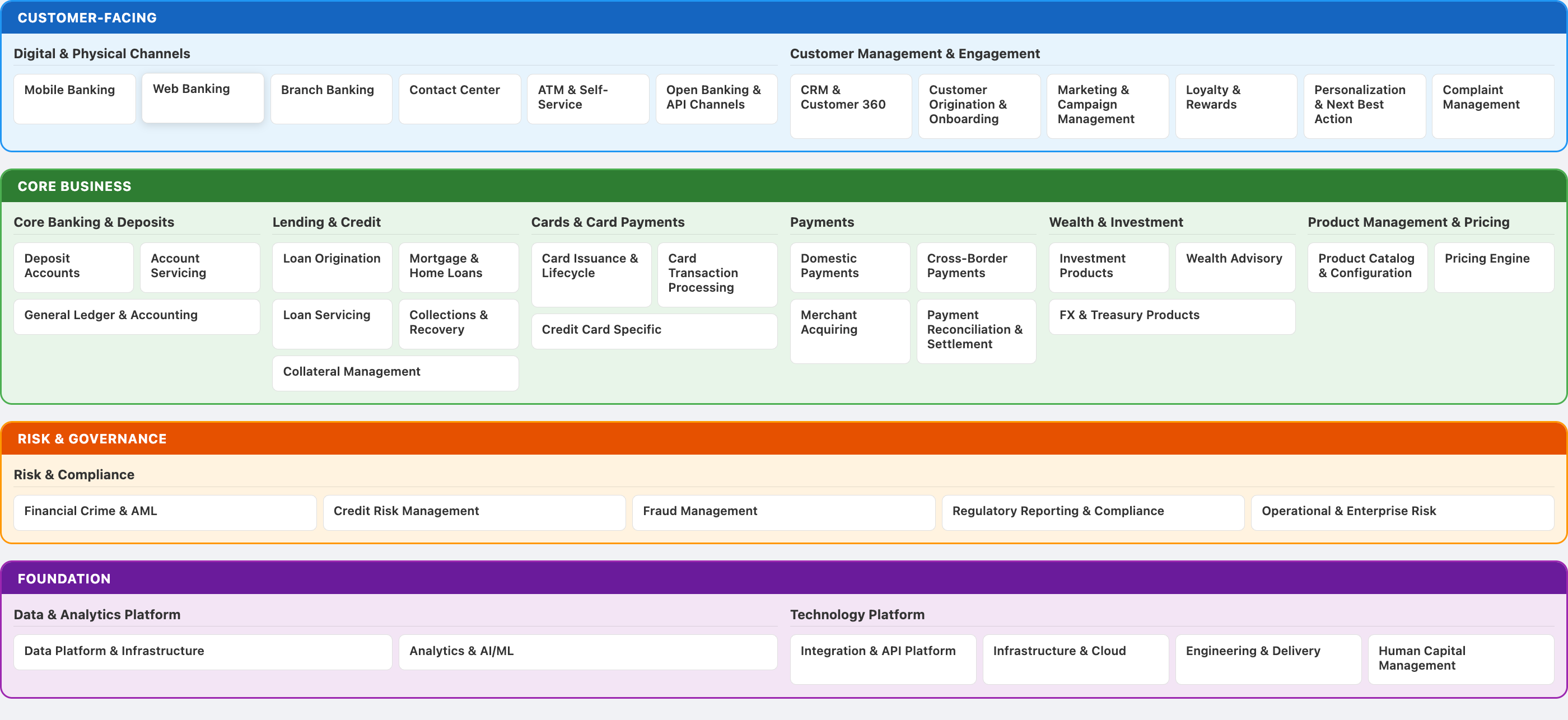
An insurer follows the same structure but with different domains: 13 L1 capabilities, from Distribution & Channel Management and New Business & Underwriting through Claims Management and Reinsurance, down to 109 L3 capabilities.
The point isn’t the count. The point is that every technology investment on your roadmap should trace back to a specific capability in this hierarchy. If it doesn’t, ask yourself why it’s on the roadmap.
What Happens When You Get the Sequence Wrong
This pattern isn’t theoretical. Here’s a composite example drawn from patterns I’ve observed across the industry.
A mid-tier retail bank set an ambitious 3-year goal: double digital lending, reduce cost-to-serve by automating manual processes, and improve onboarding speed to compete with digital-first challengers. Good goals, clearly articulated.
The CIO framed the response as a technology transformation: procure a modern Loan Origination System (LOS) and Loan Management System (LMS), migrate core banking applications to the cloud, and invest in DevOps. No capability mapping. No functional or non-functional requirements tied to business outcomes. Just a technology shopping list with a timeline.
In practice, it was technology chasing technology.
Loan approvals stayed slow because the same manual processes ran on the new systems. Customer attrition increased because digital-first competitors offered instant approvals while the bank was busy implementing platforms. Branch operations remained manual because the roadmap addressed systems, not processes. And nobody coordinated with marketing to drive digital channel adoption, or with operations to redesign the underwriting workflow.
The bottom line: $8-12M spent on technology alone — and that’s before the organizational cost of change management, retraining, and process redesign that never happened. Digital lending grew ~15% in 3 years. Respectable in isolation. Embarrassing against a 2x target. The technology wasn’t wrong. The sequence was.
Industry data backs this up. Across documented banking transformations, roughly 70% of core system modernizations fail to deliver expected outcomes. Banks that digitize channels without redesigning the underlying origination-to-fulfillment process see digital sales inch from ~8% to ~17% over five years. Banks that rewire the full journey — technology, operations, marketing, change management — go from 40% to 70% in the same period. The difference isn’t the technology. It’s whether the whole organization moves, or just IT.
Digital Loan Origination
High Criticality
STP, AI Scoring, Digital Channels
Achieved
New Systems
($8-12M Spent)
Instead of starting with a new LOS and cloud migration, the bank should have started with the business goal, identified the key capability (Digital Loan Origination), assessed it (high criticality, low satisfaction, high modernization priority), and then mapped what it would take — across technology, operations, and marketing — to move the needle.
| Step | Capability-Driven Approach |
|---|---|
| Business goal | Double digital loan origination in 3 years |
| Key capability | Digital Loan Origination (L1: Lending & Credit, L2: Loan Origination) |
| Assessment | High criticality, satisfaction 2/5, high modernization priority |
| Technology enablers | AI credit scoring, straight-through processing, automated KYC, digital servicing |
| Cross-functional plan | Marketing drives digital channel adoption; operations redesigns underwriting workflow; change management retrains branch staff |
| Platform choice | Cloud-native loan processing (cloud as enabler, not as goal) |
| Outcome | Loan approvals drop from 5 days to under 24 hours, with pre-approval for eligible customers. Revenue grows. Customers stay. |
The cloud and the new LOS would still have been part of the solution. But they would have been a means to an end, not the end itself. And the $4 out of every $5 that should go toward change management — coordinating marketing, operations, training, and process redesign — would have actually been spent.
A Note on Industry Frameworks
If you’ve worked in enterprise architecture, you’ve probably encountered TOGAF’s capability maturity model, Gartner’s ITScore, BIAN for banking, or ACORD for insurance. These are solid reference points, and I respect the thinking behind them.
But in practice, when I’m sitting in a discovery session with a CTO and a room full of business stakeholders, a 5-level CMMI maturity model or a 326-service-domain BIAN framework isn’t what moves the conversation forward. What works is something simpler: how critical is this capability, how happy are you with it today, and how urgently does it need to change?
Three dimensions. Three questions. That’s the assessment framework we’ll unpack in Part 2, alongside the transformation actions that turn assessment into execution: Migrate, Modernize, Build New, Optimize, Retire, Retain.
Not because the academic frameworks are wrong. Because in the room where decisions get made, simplicity wins.
What’s Next
Now that we’ve established why capability-driven roadmapping matters and what goes wrong when enterprises start with technology instead of business outcomes, the next step is understanding how to build one.
In Part 2, we’ll break down the assessment blueprint: how to evaluate capability gaps using three practical dimensions (criticality, satisfaction, modernization priority), how to map those gaps to specific transformation actions, and how to structure the journey from current state to target state. Not a 7-step framework for a slide deck. A practical methodology you can run in a discovery session.
/ Unni